
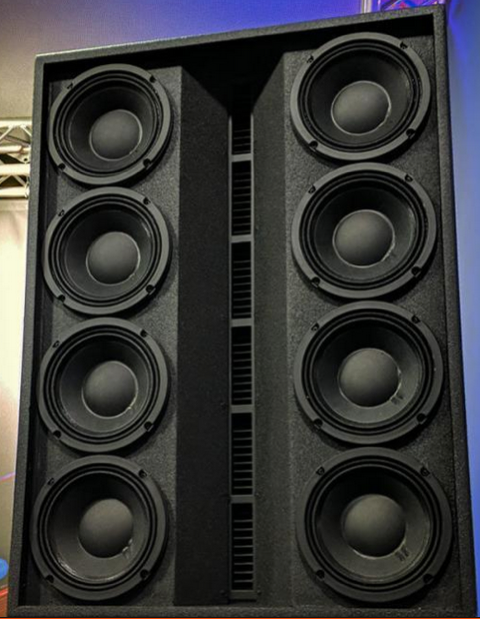
First Impressions & Real-World Experience
First impressions and actual experience can be quite different. It took me a few minutes to get used to the very even impulse response across the full volume range. I initially found myself listening for the moment when the system would “open up” and start building pressure, but that typical variation in performance wasn’t there. It’s consistent, and that takes a little adjustment.
Initial Use Cases
My first two uses involved multiple headsets alongside a live band at two different school plays, both performed in sports halls with the usual acoustic challenges.
The Karat’s 20° horizontal and 100° vertical coverage is quite narrow. However, this works in its favor—there are fewer reflections from the floor and ceiling, resulting in a more focused sound beam.
When the speakers are flown on truss, the perceived volume on stage and directly underneath is relatively low, producing a lighter, less intrusive sound in those areas.
To compensate, I covered the front row using a separate matrix with a pair of 8” speakers. Very little power was required, and importantly, there was no need to compromise the FOH EQ due to feedback—always a welcome result.

Live Band Setup (Outdoor Tent)
At another event—a fully instrumented Fleetwood Mac tribute show with support acts—the system was set up along the side of a stretch tent.
I used the Karat system on subs for FOH, with larger column speakers covering the sides. Combined with modern subwoofers, there was no need to push high volume levels.
Part of this performance, I believe, comes from the small Beyma 6.5” drivers working closely in unison with the tweeter. The result was very even coverage across both the front and sides, creating a welcoming atmosphere and a relaxed, comfortable audience experience.

Build & Handling
The speaker is rated at 2000W RMS with a peak SPL of 141 dB, and measures 500 × 710 × 345 mm, weighing 32.5 kg
manageable for a single person.
Its narrow depth places the center of gravity close to the chest when lifting, which makes handling easier. The handles are well-positioned and sufficiently large. However, when using U-brackets, a two-person setup is the safer option.
The front grille is of good quality. One minor drawback is the paint finish—it could be a bit thicker. Adding protective, hard-wearing side rails would be a nice improvement. That said, at this price point, using flight cases for mobile applications is a reasonable expectation.

Conclusion
The Karat 8 performs similarly to high-quality column speakers, but with greater power.
As someone who prefers coaxial designs, I was initially concerned about the horizontal layout of dual drivers with a tweeter in between. This kind of configuration can sometimes lead to phasing issues when moving across the listening area or even when turning your head.
To my relief, I didn’t notice any significant issues—except at very close range.
Another strong point: many compact point-source speakers require heavy processing and can sound somewhat compressed. The Karat, by comparison, requires very little EQ and maintains a more open, natural sound.

Would I buy them again ? YES
I do think they have the potential to become a timeless tool. Thanks to the Solton Family for delivering a great Product.